This week, I watched a Tedtalk about the concerns held for our ocean. "The dead-zones of the Gulf of Mexico" is a Tedtalk featuring Nancy Rabalais about how the pollution and waste we're producing is generating dead-zones in the Gulf of Mexico.
Now, you're probably thinking what is a dead-zone? A dead-zone is a blend of sediments, dissolved molecules, nitrogen, and phosphorus (Rabalais). The mixture causes problems within the aquatic ecosystem in the Gulf because there's not enough oxygen for life to survive, but there's an abundance of nitrogen and phosphorus, creating the perfect environment for a certain algae to grow.
What causes a dead-zone? Dead-zones are created by runoff and pollution leaking into the Gulf (Rabalais). Farming is the main contributor to this dispute we're facing. Fertilizer contains nitrogen and phosphorus, creating the perfect conditions for phytoplankton, a microscopic plant, to overproduce (Rabalais). When phytoplankton overproduce, the food web is disrupted. With an absurd amount of phytoplankton, their food source quickly begins to diminish. Phytoplankton then search for another food source, creating shifts in the food web.
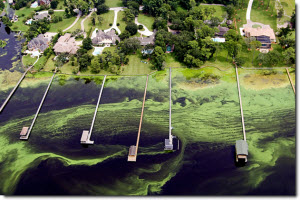 |
| ("Harmful Algal Blooms Cause Thick, Green Muck...") |
These negative impacts the Gulf is suffering from pose a threat to us as well. Oxygen levels decreasing leads to a decrease in population of a variety of different species in the Gulf. People in our community incorporate different types of sea food into their diet and rely on this profession as a source of income. If fishermen are collecting less sea food, workers source of income and career are in jeopardy.
After listening to this Tedtalk, I was slightly enraged. Why is this the first time I've heard about dead-zones? Not once did my science teachers mention dead-zones during their year long course. Then I began to wonder, how many other people out there are unaware of this complication? Would we have already fixed this issue if people understood the severity of it?
Nancy Rabalais voiced some ways we can combat this dilemma. One way we can fix this horrid issue is by using less fertilizer. If we use less fertilizer, the amount of nitrogen and phosphorus runoff in the Gulf will decrease. The Gulf should then be able to recover and the aquatic ecosystem will survive.
Another way we can fix these dead-zones is by using precision fertilizing. Precision fertilizing uses technology to examine the growth of plants and their productivity rates (Bryce). By using precision fertilizing, this technology would allow for farmers to put an end to over fertilizing. Remote-sensing technology is used to locate areas that have a low productivity rate. Not only would this save farmer's a great deal of money, but it would be beneficial to our planet.
Dead-zones are disrupting the marine ecosystem. If action is taken now, the Gulf can recover on its own, but it's only a matter of time before the damaging effects of dead-zones become irreversible. We know the action needed to prevent this tragedy, we have the supplies. Now, we need to act.
Works Cited
Bryce, Emma. "Here's How Precision Agriculture Could Help Farmers Reduce Fertilizer Use."
Anthropocene, Future Earth, Apr. 2019, www.anthropocenemagazine.org/2019/04/heres-how-
precision-agriculture-could-help-farmers-reduce-fertilizer-use/. Accessed 25 Nov. 2019.
Harmful Algal Blooms Cause Thick, Green Muck That Impacts Clear Water, Recreation, Businesses
Harmful Algal Blooms Cause Thick, Green Muck That Impacts Clear Water, Recreation, Businesses
and Property Values. United States Environmental Protection Agency,
www.epa.gov/nutrientpollution/effects-dead-zones-and-harmful-algal-blooms. Accessed 25 Nov. 2019.
Rabalais, Nancy. "The 'dead Zone' of the Gulf of Mexico." Ted, 2017,
www.ted.com/talks/nancy_rabalais_the_dead_zone_of_the_gulf_of_mexico/transcript. Accessed 25 Nov. 2019.
Rabalais, Nancy. "The 'dead Zone' of the Gulf of Mexico." Ted, 2017,
www.ted.com/talks/nancy_rabalais_the_dead_zone_of_the_gulf_of_mexico/transcript. Accessed 25 Nov. 2019.
Nice title and conversational style. There are harmful effects of algae blooms on humans and animals too; it's while lakes and ponds, even up here, get shut down in the summer.
ReplyDeleteInteresting concept, I also find it interesting that we are never taught about this in school. Do you think you are trying to hide something? And who do you think is trying to hide it from us?
ReplyDeleteDo you think that making the public more aware would really fix this issue? Or just a certain group of people need to know for it to be fixed?
ReplyDeleteDo you think any real action will be taken to prevent the damaging effects of these dead-zones?
ReplyDeleteHi Isaiah!
DeleteI like to think action will be taken to prevent the effects of dead-zones. With so many political candidates advocating for making positive changes to our planet, I have some hope there will be change. As of right now, people are presenting plans and some are putting them into motion, however I haven't done much research on dead-zones in other places. Hope this answered your question!
This is shocking to see because I have never heard about these before. Will there be any way to clean up the dead-zones? Or are they going to be stuck there for a long time?
ReplyDelete